Tag: politics

  • Red Disability, Queer Death, and Native Love “at the End”

    Red Disability, Queer Death, and Native Love “at the End”

    Your art will live on. A call across time and space. Honour the sacredness of how we remind one another that we existed across time.

    — Maria Buffalo, as read by Jessie Loyer in nanekawâsis (2024)

    There are empty spaces that must be respected—those often long periods when a person can’t see the pictures or find the words and needs to be left alone.

    — Tove Jansson, Fair Play (1989)

    indian is an idea / some people have / of themselves
    dyke is an idea some women / have of themselves

    — Some Like Indians Endure, Paula Gunn Allen (1988)

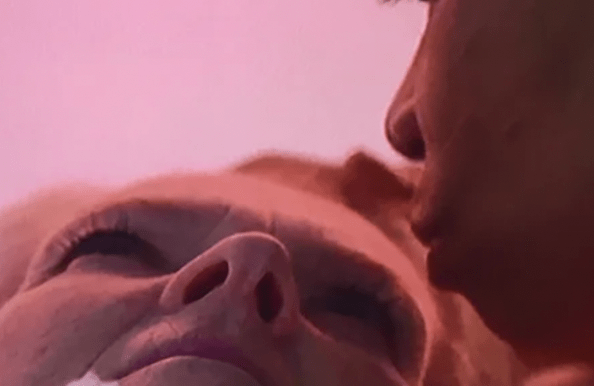
    Métis filmmaker Conor McNally has been meticulously working on his documentary feature debut nanekawâsis—about the life and work of Cree painter George Littlechild—for years. Despite being a widely respected Plains Cree artist for decades, I was surprised to learn that Littlechild’s work has not been collected by the National Gallery of Canada, and that he doesn’t have a Wikipedia page. At this pivotal moment in Littlechild’s long and storied career, McNally’s film plays a crucial role in commemorating Littlechild’s legacy. With its focus on the relationships that shape Littlechild’s work—such as his longtime love for his partner—nanekawâsis tells a story of enduring queer love in an Indigenous apocalypse. 

    Queer love in the apocalypse has become a literary and visual trope in recent years. Amid apocalyptic realities—such as widespread disease and environmental crises—conservative social policies targeting 2LGBTQ+ people have started to permeate everyday discourse. Representations of queer love “at the end” have emerged in response.

    At first glance, these representations might seem like expressions of endurance: We’re here, we’re queer, in any mode or reality known on Earth, and to queered peoples. Yet, fetishistic themes of disability and death mar these narratives, hindering any possibility of queer futurity (however ironic such a proposal may be). Amidst a sea of narratives exploring queer deviance and death, nanekawâsis stands out as a realized future, and a remarkable and unexpected memorialization of minor histories and quiet archives.

    Read full column here.
  • Inferno of Bodies

    Inferno of Bodies

    Thank you for joining me for this edition of I Saw Some Art. Let’s address a critical issue upfront: Palestine will be free. Social media platforms were recently inundated with images depicting demonstrations in major Canadian cities advocating for Palestine and demanding an immediate cessation of the siege, occupation, and ongoing atrocities in the Gaza Strip and West Bank. Indigenous communities from “the river to the sea” have united in a collective movement to denounce the unfolding genocide in Palestine, driven by imperialist rhetoric.

    The narratives surrounding Indigenous peoples—from Palestine to Turtle Island—reflect the prevailing sentiments within settler-colonial societies. It is striking to witness the juxtaposition of watching Killers of the Flower Moon—nominated for several Academy Awards, yet having won none—while witnessing the ongoing genocide of Indigenous peoples in real-time.

    Killers of the Flower Moon brought to mind my readings of Dante’s Inferno during my formative years as an undergrad. Dante Alighieri, an Italian poet and philosopher, is celebrated for being the first poet to incorporate common speech into his literary works. Before Dante, poetry was exclusively written in Latin, accessible only to the upper class and nobility. Dante’s works, however, resonated with the people of Italy and played a pivotal role in establishing a common language across Western Europe. Embedded within his writings is the early framework of social hierarchy, juxtaposed with patriarchy—wherein man, ordained by God, is placed above woman, child, and even community. By making literature accessible to the common “man,” Dante imbued men with a sense of godlike moral and logical reasoning, or so the Enlightenment dogmas say.

    When I first encountered Dante’s Inferno, its depiction of the circles of hell struck me as a reflection of our earthly existence under settler-colonial regimes. Dante’s adherence to Christian symbolism instills the verses of Inferno, or Hell, with a profound resonance, resembling thinly veiled metaphors for the moral consequences of human embodiments on Earth.

    For Dante, Hell is a landscape heavily influenced by Christian and colonizing dogmas, and serves as an allegory of the moral consequences of the flesh. To me, an NDN in 2024, Hell is the reign of Western colonialism and its doctrines, a dominance that not only demands scrutiny but also calls for its dismantling and the envisioning of alternatives. Hell is man, ordained with the power of God, serving as a tool for the conquest of those deemed lesser forms of life on Earth, where the circles of Hell are tightly bound. Hell is other people.

    In contemporary discourse, if we examine the representation of Indigenous life, such as that depicted in Killers of the Flower Moon, it becomes evident that colonial narratives have persisted since the 14th Century. This enduring narrative suggests a troubling continuity, wherein Indigenous peoples are subjected to felt settlements akin to the infernal torments envisioned by Dante.

    Read full column here.